
AI The Growing Danger of Our Time
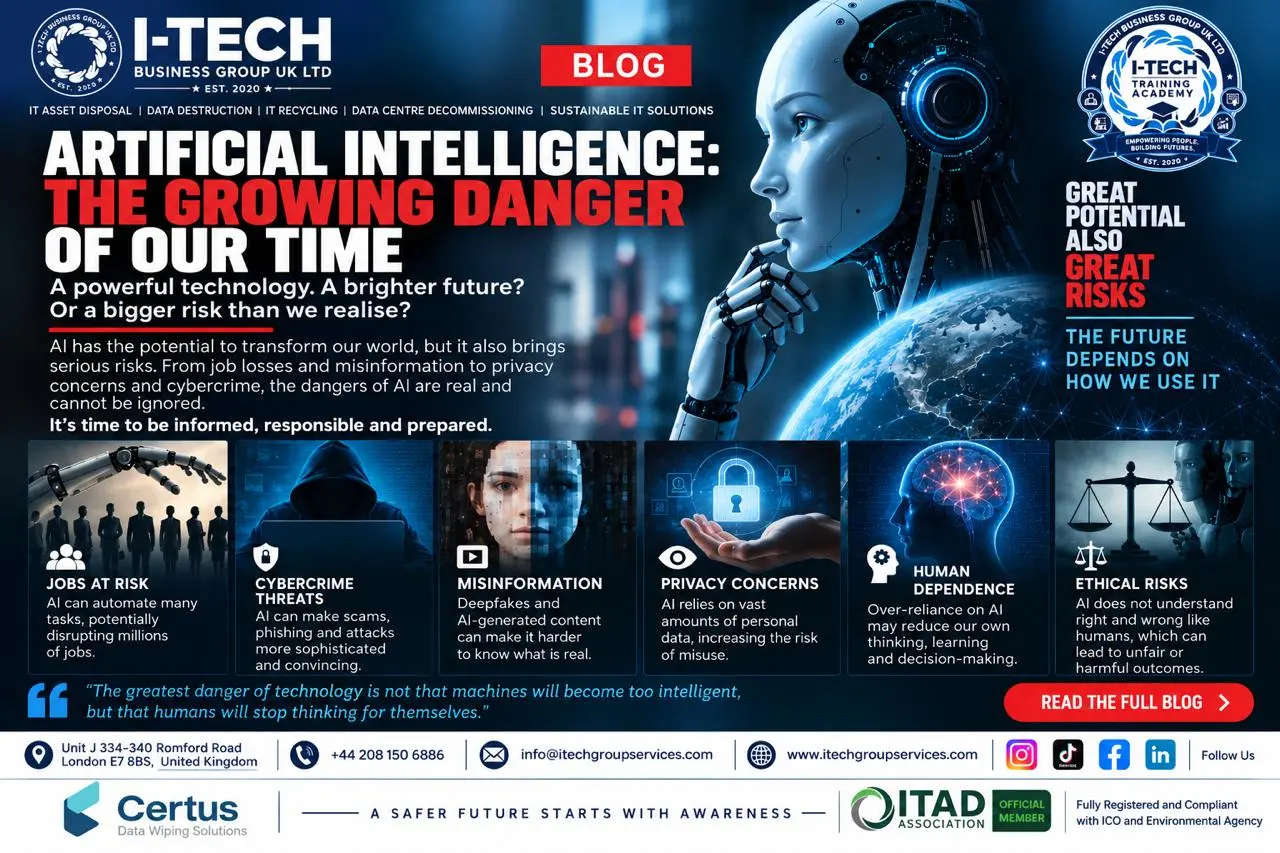
Artificial Intelligence (AI) is no longer a technology of the future. It is already part of our everyday lives. From smartphones and social media to education, healthcare, banking and business, AI is changing the way we live and work.
But while AI offers enormous opportunities, we should not ignore an important question:
Are we developing artificial intelligence faster than we are developing the ability to control it?
The rapid growth of AI has created genuine concerns about privacy, employment, misinformation, cybersecurity and human dependence on technology.
AI Can Threaten Jobs
One of the biggest concerns is the impact of AI on employment.
• AI systems can now write articles, create images, analyse documents, answer customer questions, write computer code and perform many tasks that previously required human workers.
• Automation has always changed the workplace, but modern AI is different because it can perform tasks involving language, creativity and decision-making.
• If organisations replace people with AI simply to reduce costs, millions of workers could eventually face significant disruption.
• The challenge is not necessarily that AI will eliminate every job. The greater concern is that the skills required for many jobs may change faster than people can adapt.
AI Can Spread Misinformation
• Another danger is the ability to create convincing fake content.
• AI can generate realistic photographs, videos, voices and written material. This technology can be used to create deepfakesthat make it appear as though someone said or did something that never happened.
• Imagine receiving a video showing a political leader making a shocking announcement—or hearing a recording of a family member asking for money—only to discover later that AI created it.
• As synthetic media becomes more convincing, society may face a difficult problem:
How can we know what is real?
Privacy Is Becoming More Difficult
AI systems depend heavily on data.
• The more information an AI system can access, the more powerful its analysis can become. But this creates concerns about how personal information is collected, stored and used.
• Our photographs, voices, locations, online behaviour, purchasing habits and communications can reveal enormous amounts about us.
• If this information is misused, stolen or handled irresponsibly, the consequences could be serious.
• Privacy should not become the price we pay for technological convenience.
AI Can Be Used for Cybercrime
• AI can also make cyberattacks more sophisticated.
• Criminals can use AI to produce convincing phishing messages, automate scams, impersonate people and identify potential targets.
• Traditional scams often contain obvious warning signs. AI can make fraudulent communication much more convincing and personalised.
• This means individuals and organisations cannot rely solely on technology to protect themselves.
• Human awareness, cybersecurity education and strong security controls remain essential.
AI Can Make People Too Dependent
Perhaps one of the less obvious dangers is psychological and intellectual dependence.
If we allow AI to write everything, answer every question, make every decision and solve every problem, we may gradually stop developing our own abilities.
• Students may use AI instead of learning.
• Employees may rely on AI instead of thinking critically.
• Businesses may follow AI recommendations without questioning them.
• Technology should assist human intelligence—not replace human judgment.
AI Does Not Always Understand Right and Wrong
• AI can process enormous amounts of information, but processing information is not the same as possessing human wisdom.
• An AI system does not experience compassion, responsibility or morality in the same way humans do.
• This becomes particularly important when AI is used in areas such as recruitment, finance, policing, healthcare or other decisions that can significantly affect people’s lives.
• A system can produce an answer that appears logical while still being unfair, inaccurate or harmful.
That is why important decisions should not be handed over to AI without meaningful human oversight.
The Biggest Danger May Be Human Misuse
It is easy to describe AI itself as the enemy.
But perhaps the greater danger is what humans choose to do with it.
A hammer can build a house or cause harm. The technology itself is not necessarily responsible for the outcome—the person using it is.
The same principle applies to AI.
AI can help doctors analyse information, help students learn, help businesses become more efficient and help researchers solve difficult problems.
But the same technology can also be used for manipulation, surveillance, fraud and misinformation.
Therefore, the real challenge is not simply creating more powerful AI.
The challenge is creating powerful AI that remains under responsible human control.
What Should We Do?
We should not be afraid of technological progress, but neither should we blindly trust it.
• Governments need appropriate regulations.
• Businesses need responsible AI policies.
• Schools need to teach digital and AI literacy.
• Individuals need to learn how to identify misinformation and protect their personal information.
• And developers need to consider safety, privacy and accountability alongside innovation.
Most importantly, humans must remain responsible for the consequences of decisions made with AI.
Conclusion
Artificial Intelligence may become one of the most powerful technologies ever created.
That power can bring enormous benefits—but it also creates enormous responsibility.
The question is not simply:
• How intelligent can we make AI?
• Perhaps the more important question is:
• How responsibly can we use the intelligence we create?
• AI does not have to become humanity’s greatest danger.
But if we develop it faster than we develop the laws, ethics, education and safeguards necessary to control it, we may create problems that are extremely difficult to reverse.
The future of AI should not be about replacing humanity. It should be about empowering humanity—without losing control of the technology along the way.
The greatest danger of technology is not that machines will become too intelligent, but that humans will stop thinking for themselves.