
Why Organisations Need to Think Beyond Disposal
The Hidden Cost of Old IT Equipment
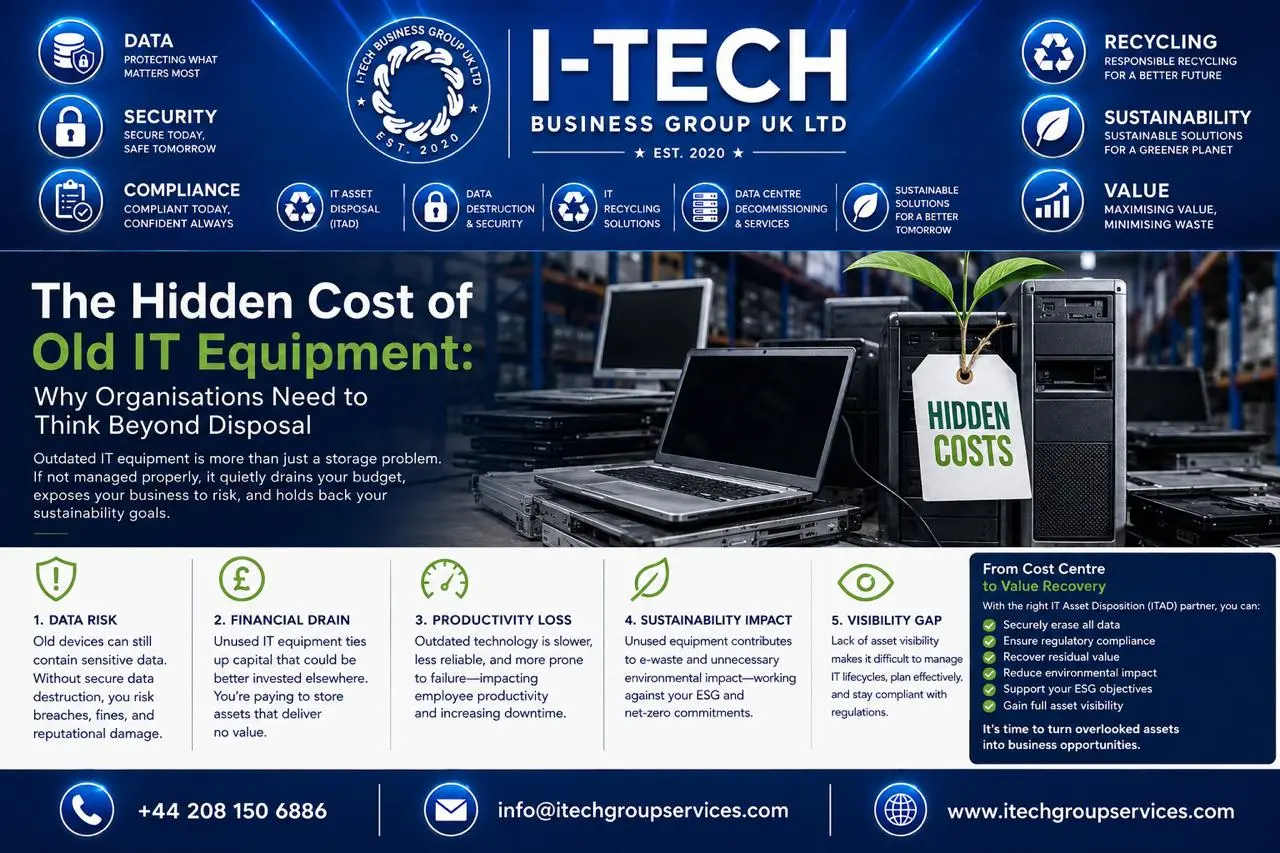
Old technology is not simply an IT problem. It can become a financial, security, operational and environmental liability when organisations fail to manage it properly.
Every organisation eventually reaches the same point
Laptops are replaced. Desktops are upgraded. Servers are decommissioned. Networking equipment becomes obsolete. Employees leave and return devices. Offices relocate. Technology projects are completed.
And then the old equipment starts accumulating.
It may sit in a locked storeroom, an unused office, a warehouse, a server room or simply a corner of the IT department.
The common assumption is
“We’ll deal with it later.”
But old IT equipment does not become risk free simply because it is no longer being used.
In fact, an unmanaged technology estate can quietly create costs and risks that are far greater than the organisation realises.
The modern approach should therefore move beyond simply asking:
How do we dispose of this equipment?
The better question is:
What is the most secure, commercially sensible and environmentally responsible outcome for every asset?
1. Old IT Equipment Can Still Contain Valuable Data
A device may be obsolete from an operational perspective while remaining highly valuable to a cybercriminal.
Laptops, desktops, servers, hard drives, SSDs, USB devices and other storage media can contain personal information, business documents, credentials, emails, customer information, financial records and other confidential data.
The fact that a computer has been removed from an employee’s desk does not mean the information stored on it has disappeared.
The UK’s Information Commissioner’s Office recommends organisations maintain records of secure hardware disposal, document procedures, retain destruction logs and obtain evidence when third parties securely destroy hardware on their behalf.
This is why responsible IT asset disposal should begin with data security, not with the recycling bin.
A professional disposal process should establish:
- What the asset is
- Who owns it
- Where it came from
- What data it may contain
- How the data will be sanitised
- What happened to the asset afterwards
- What evidence exists to demonstrate the outcome
The result is a much stronger audit trail and significantly greater confidence.
2. The Cost of Keeping “Unused” Equipment Is Often Invisible
Businesses frequently calculate the cost of purchasing technology.
Far fewer calculate the cost of keeping technology they no longer need.
Consider an organisation holding hundreds of retired laptops.
Those devices may occupy:
- Office space
- Warehouse capacity
- IT staff time
- Security controlled storage
- Inventory management resources
- Insurance capacity
- Administrative attention
There is also another problem: depreciation
Technology generally does not become more valuable because it sits unused for another year.
A device that could potentially have been refurbished, redeployed or remarketed today may have considerably less residual value after another period of storage.
The longer organisations delay decisions, the more opportunities they may lose.
3. Your IT Department Should Not Become a Storage Department
IT teams are already responsible for infrastructure, cybersecurity, user support, cloud services, networks, applications, projects and business continuity.
Managing piles of obsolete equipment should not become an unofficial additional responsibility.
Imagine an IT technician spending hours:
- Identifying old equipment
- Searching for serial numbers
- Moving equipment between rooms
- Checking whether devices are still required
- Preparing assets for collection
- Chasing documentation
- Answering questions about missing equipment
That is time that could otherwise be invested in improving the organisation’s technology environment.
A structured IT asset lifecycle can remove much of this administrative burden.
4. Old Equipment Can Represent Recoverable Business Value
One of the biggest mistakes organisations make is treating every retired device as waste.
Not every old laptop is waste.
Not every desktop needs to be dismantled.
Not every server has zero value.
Depending on condition, specification, age and market demand, some equipment may have a potential second life.
A professional IT asset disposition process can therefore separate equipment into appropriate routes such as:
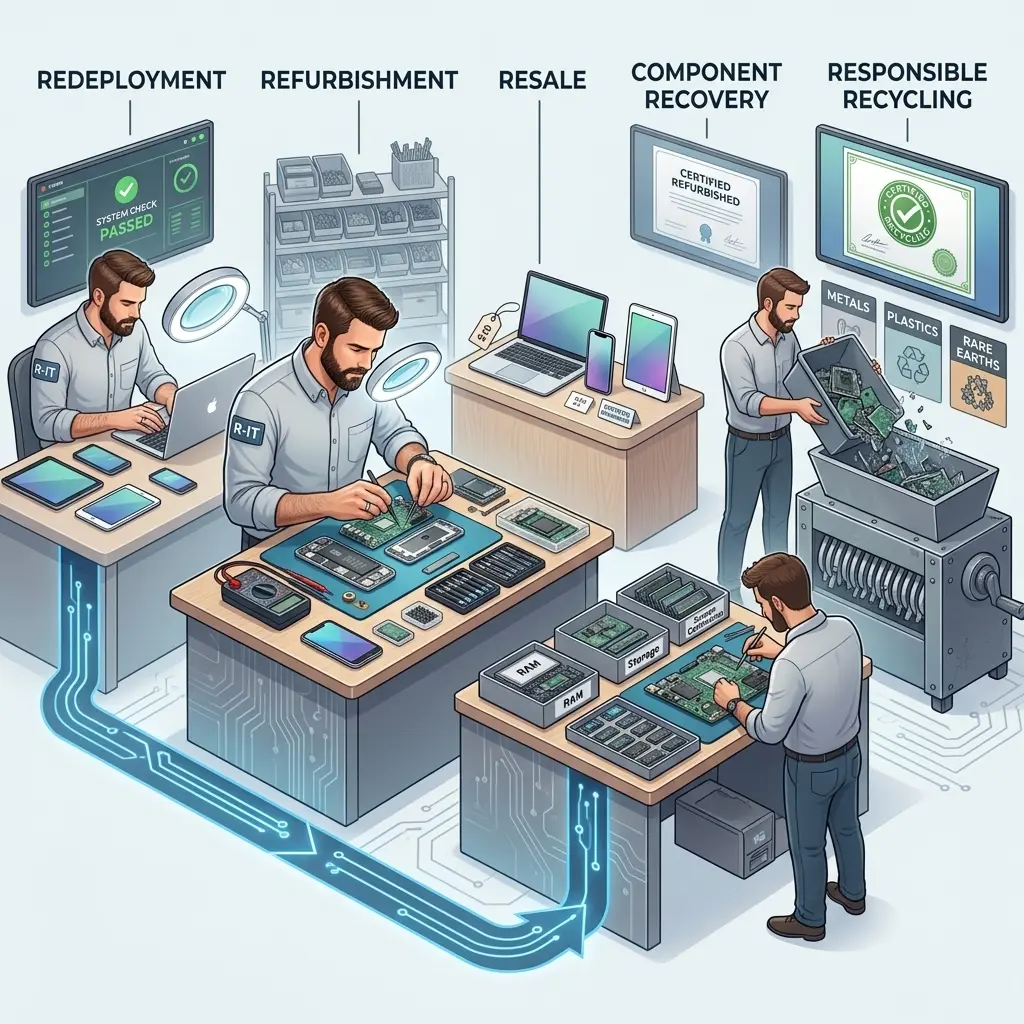
Redeployment → Refurbishment → Resale → Component Recovery → Responsible Recycling
This creates a circular approach to technology rather than a simple disposal model.
Where suitable, recovering residual value from assets can help organisations offset part of their technology lifecycle costs.
The principle is simple:
An asset that has reached the end of its useful life for one organisation may still have value elsewhere.
5. Sustainability Begins Before the Recycling Stage
Sustainability is often discussed as if recycling is the final answer.
Recycling is important, but responsible technology management should begin much earlier.
The most sustainable decision may be to extend the useful life of equipment.
Where appropriate, a device can potentially be:
- Repaired
- Refurbished
- Reconfigured
- Redeployed
- Resold
- Used for parts
Only when reuse or recovery is no longer appropriate should recycling become the next route.
UK environmental guidance also emphasises preparing suitable WEEE for reuse and prioritising reuse where possible before recycling or recovery.
This is the foundation of a more circular technology economy.
Instead of thinking:
Buy → Use → Throw Away
organisations should increasingly think:
Plan → Procure → Deploy → Manage → Recover → Reuse → Recycle
6. ESG Requires Evidence, Not Just Statements
Many organisations now have sustainability objectives.
But saying that a company is committed to sustainability is very different from being able to demonstrate what actually happened to its technology assets.
For example, an organisation may want to know:
- How many devices were collected?
- How many were reused?
- How many were refurbished?
- How many were recycled?
- How much equipment avoided unnecessary disposal?
- How many assets were securely sanitised?
- What documentation exists?
- Where did the equipment ultimately go?
This is where structured ITAD reporting becomes increasingly important.
A good process can transform an otherwise invisible activity into measurable evidence.
Instead of simply saying:
“We recycle our old IT equipment.”
an organisation can demonstrate:
“We have a controlled lifecycle process with documented asset movements, secure data sanitisation, recovery outcomes and responsible recycling.”
That is a much stronger position for management, procurement, auditors and sustainability teams.
7. Compliance Does Not End When Equipment Leaves Your Office
Another common misconception is that responsibility ends when a collection vehicle removes equipment from the premises.
It doesn’t necessarily work that way.
Organisations need to understand what happens to their equipment after collection and ensure appropriate processes are in place.
For WEEE, the Environment Agency provides guidance covering classification, storage, treatment and appropriate controls. Its guidance also states that WEEE must be stored or treated in accordance with an environmental permit or relevant exemption where applicable.
That means businesses should consider the entire chain:
Collection → Identification → Secure Storage → Data Sanitisation → Reuse/Recovery → Recycling → Reporting
The more controlled the chain, the easier it becomes to demonstrate responsible asset management.
8. Asset Visibility Is One of the Most Important Pieces
You cannot effectively manage what you cannot identify.
Organisations should aim to maintain visibility of their technology assets throughout the lifecycle.
That means knowing:
- What equipment exists
- Where it is located
- Who is responsible for it
- Its current status
- Its condition
- Its serial number or asset identifier
- Whether it contains storage media
- Whether it has been retired
- What happened to it after retirement
The National Cyber Security Centre specifically highlights asset discovery and asset management as important parts of secure decommissioning, noting that assets no longer required can become liabilities if they create opportunities for unauthorised access or exposure.
Good asset visibility therefore supports more than finance
It supports cybersecurity, compliance, operational efficiency and sustainability.
From Cost Centre to Strategic Asset Management
The biggest change organisations can make is changing their mindset.
Old IT equipment should not automatically be viewed as rubbish.
It should be viewed as an asset requiring a controlled business decision.
For every retired device, organisations should ask:
Can we securely redeploy it?
If yes, extend its useful life.
Can it be refurbished?
If yes, restore value rather than immediately recycling it.
Can it be resold?
If yes, recover potential residual value.
Can components be recovered?
If the complete device has no viable second life, individual components may still have value.
If it must become waste, can it be processed responsibly?
Ensure the correct route, documentation and environmental controls are followed.
This approach creates a much more intelligent IT lifecycle.
What Should Organisations Do Next?
A practical starting point is a technology lifecycle review
Begin by identifying all equipment that is:
- No longer required
- Awaiting disposal
- Stored for an extended period
- Damaged or obsolete
- Returned by employees
- Replaced during technology refresh projects
- Held as unidentified stock
Then categorise the assets.
Category 1 — Redeploy
Equipment that can continue serving the organisation.
Category 2 — Refurbish
Equipment that requires repair, testing or reconfiguration.
Category 3 — Remarket
Equipment with potential residual value.
Category 4 — Recover
Equipment suitable for component recovery.
Category 5 — Recycle
Equipment that has reached genuine end of life.
At every stage, data security and chain of custody controls should remain central.
The Future of IT Disposal Is Not Really About Disposal
The phrase “IT disposal” can make the process sound simple
But modern organisations need something more sophisticated.
They need a technology lifecycle strategy that combines:
Security + Compliance + Asset Visibility + Value Recovery + Sustainability
That is the real opportunity.
The objective is not simply to remove old computers from a building.
The objective is to make sure every technology asset reaches its most secure, valuable and environmentally responsible next stage.
How i-Tech Business Group UK Ltd Can Help
At i-Tech Business Group UK Ltd, we believe IT asset disposal should be treated as part of the wider technology lifecycle—not as an afterthought.
We help organisations manage retired technology through structured IT asset disposition services designed around security, accountability, value recovery and environmental responsibility.
Our services can support organisations with:
- IT Asset Disposal
- Secure Data Sanitisation
- IT Equipment Collection
- Asset Inventory & Tracking
- IT Recycling
- WEEE Processing
- Hardware Recovery
- Refurbishment & Reuse
- Office & IT Clearance
- Asset Reporting
- Secure End of Life Management
Whether you are replacing a handful of laptops or managing a large scale technology refresh, the right process can help reduce risk, recover value and support your sustainability objectives.
Final Thought
The biggest mistake organisations can make with old IT equipment is assuming that because technology has reached the end of its useful life, it has reached the end of its importance.
It hasn’t.
That old laptop may still contain sensitive information.
That server may still have recoverable value.
That unused equipment may still be consuming valuable storage space.
And that collection of obsolete devices may represent an opportunity to demonstrate measurable progress towards a more circular and responsible technology model.
Don’t simply dispose of technology. Manage its next chapter.
i-Tech Business Group UK Ltd
Secure today. Save tomorrow. Sustain forever.
PHONE
+44 208 150 6886
info@itechgroupservices.com
WEBSITE
www.itechgroupservices.com