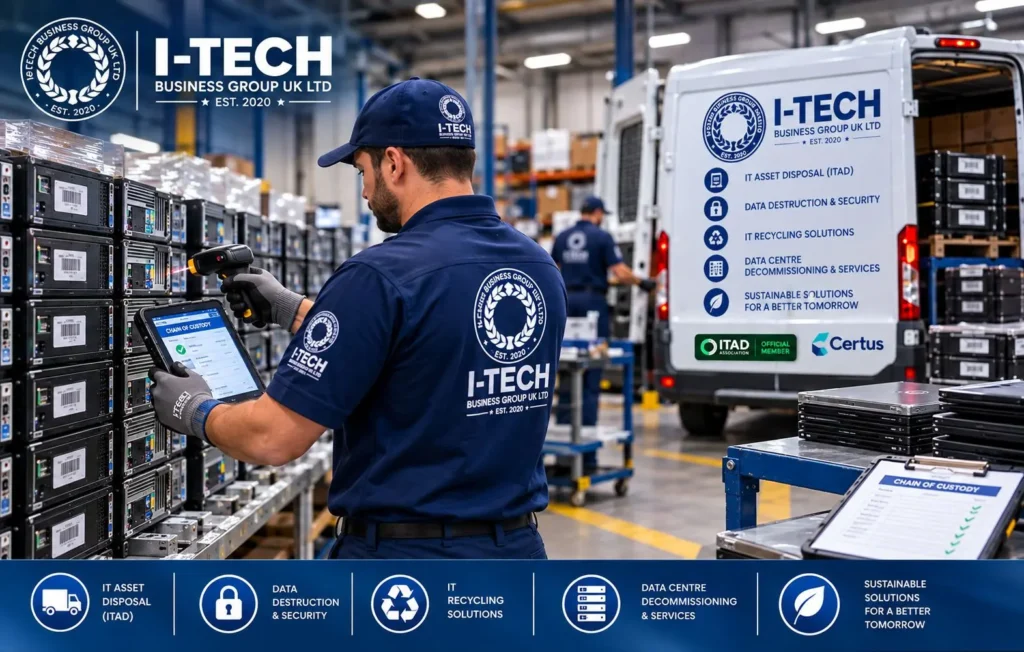
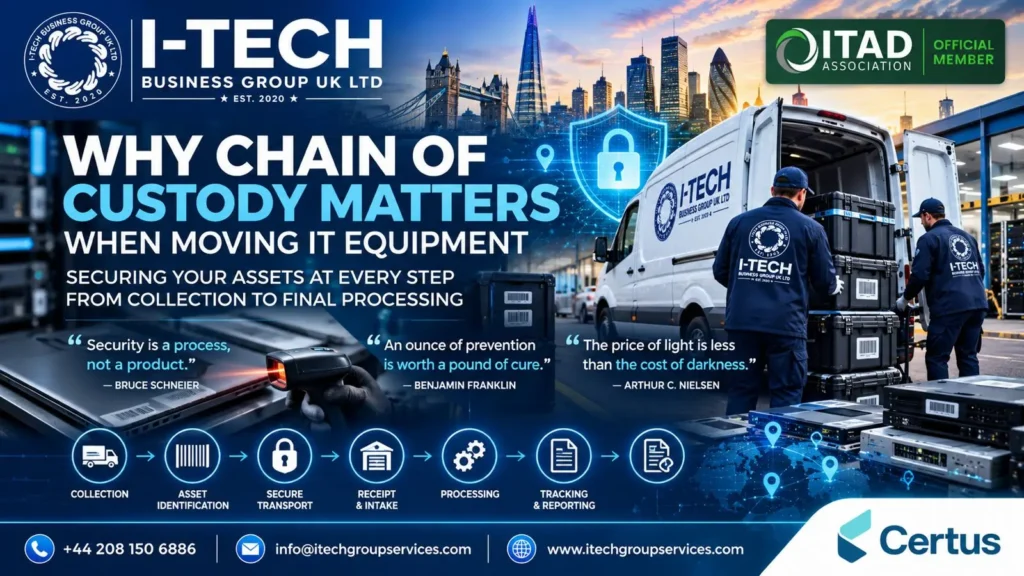
Why Chain of Custody Matters When Moving IT Equipment
When an organisation replaces computers, servers, laptops, storage devices or networking equipment, the focus is often on what happens at the end of the process — secure data wiping, refurbishment, resale or recycling.
But there is another important stage that deserves equal attention:
What happens to the equipment between leaving your premises and reaching the facility where it will be processed?
This is where chain of custody becomes important.
For businesses handling sensitive information, the security of IT equipment should not begin when a device reaches a processing facility. It should begin when that device is handed over for collection.
What Is Chain of Custody?
In IT Asset Disposal (ITAD), chain of custody refers to the documented control and movement of equipment from one responsible party to another throughout the disposal process.
A typical journey might look like this:
Collection → Identification → Secure Loading → Transportation → Receipt → Processing → Data Sanitisation → Reuse/Remarketing/Recycling → Final Reporting
Each stage should provide appropriate accountability.
The objective is simple:
At any point in the process, an organisation should be able to understand what happened to its equipment and who was responsible for it.
Why Does Chain of Custody Matter?
An old laptop may look like an ordinary piece of equipment.
But inside that laptop could be:
• Customer information
• Employee records
• Emails
• Financial information
• Business documents
• Passwords and credentials
• Commercially sensitive information
• Cached or locally stored data
The fact that a device has been removed from an office does not mean the information stored on it has disappeared.
This means that collection and transportation are security stages, not simply logistical activities.
As Bruce Schneier famously put it:
“Security is a process, not a product.”
The principle applies particularly well to IT asset disposal. Security should be considered throughout the asset’s journey rather than treated as a single event.
1. Security Starts at Collection
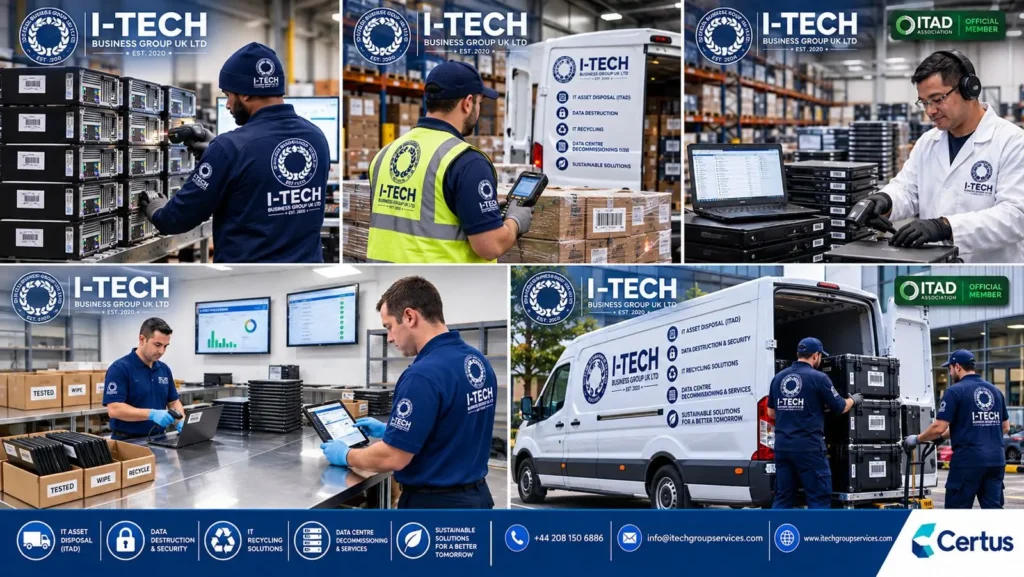
The first stage of chain of custody is the physical collection.
A professional collection process should establish:
• What equipment is being collected
• Where it is being collected from
• Who is authorised to release the equipment
• Who is authorised to collect it
• How the assets are identified
• What quantity is being transferred
• Whether any discrepancies exist
For larger collections, asset tags, serial numbers or barcodes can provide an important reference point.
The collection record then becomes the starting point for the asset’s journey.
2. Asset Identification Creates Accountability
Imagine an organisation sends 250 laptops for disposal.
If those laptops are simply loaded onto a vehicle without proper identification, it becomes much harder to establish exactly what was collected.
A structured ITAD process can associate each asset with information such as:
Asset ID → Serial Number → Collection → Processing → Data Sanitisation → Final Disposition
This creates a traceable record.
It also helps identify exceptions.
For example:
• An asset expected at collection is missing.
• A serial number does not match the inventory.
• An additional device is discovered.
• A device arrives damaged.
• An asset cannot be located during reconciliation.
Good asset tracking does not necessarily prevent every problem, but it makes problems easier to identify and investigate.
3. Secure Loading Matters
Once equipment is collected, it needs to be loaded securely.
This can be particularly important when dealing with:
• Laptops
• Servers
• Hard drives
• SSDs
• Smartphones
• Tablets
• Networking equipment
• Backup devices
• Data-centre equipment
Equipment should be handled appropriately to reduce the risk of loss, damage or unauthorised access.
The loading process should also maintain a clear connection between the physical equipment and the corresponding asset records
4. Transportation Is Part of the Security Process
Transportation is sometimes treated as simply moving equipment from A to B.
For sensitive IT equipment, it should be considered more carefully.
During transportation, equipment is physically outside the customer’s premises but may still contain data.
Businesses should therefore consider controls such as:
• Authorised collection personnel
• Appropriate vehicle security
• Secure loading procedures
• Controlled access to collected equipment
• Collection documentation
• Asset tracking
• Defined delivery destination
• Receipt and reconciliation procedures
The precise controls should reflect the type and sensitivity of the equipment being transported.
5. What Happens If Equipment Is Lost During Transit?
This is why a clear chain of custody is essential.
Without accurate records, an organisation may struggle to answer basic questions:
• Was the equipment collected?
• Which device was involved?
• Who received it?
• When did it leave the customer’s premises?
• When was it received at the processing facility?
• Was it recorded on arrival?
• Had its data been sanitised?
A documented chain of custody helps establish an evidence trail.
It turns an informal movement of equipment into a controlled process.
6. Receipt and Reconciliation
The chain of custody should continue when equipment arrives at the processing location.
The receiving team can reconcile the incoming equipment against the collection information.
This can help identify:
• Missing assets
• Unexpected assets
• Incorrect serial numbers
• Damaged equipment
• Quantity discrepancies
• Incorrect asset records
Only after receipt and reconciliation should the equipment move into the appropriate processing workflow.
7. Data Sanitisation Must Be Linked to the Correct Asset
One of the most important parts of ITAD is making sure the correct data-bearing device receives the correct sanitisation treatment.
A data sanitisation record is much more useful when it can be associated with a specific asset.
For example:
Asset ID: IT-004582
Serial Number: XXXXXXXX
Device: Laptop
Sanitisation Status: Completed
Result: Pass
Processing Date: Recorded
Final Disposition: Reuse / Remarketing / Recycling
This creates a stronger audit trail than simply recording:
“250 laptops wiped.”
The goal is traceability at the asset level wherever practical.
8. Chain of Custody Supports Responsible Reuse
Secure disposal does not always mean destruction.
Some equipment may still have useful life.
After appropriate assessment and data sanitisation, equipment may potentially be:
• Reused
• Refurbished
• Remarketed
• Donated where appropriate
• Recycled when it is no longer suitable for reuse
A documented chain of custody helps maintain visibility regardless of the final destination.
9. Documentation Is More Than Paperwork
Documentation can sometimes be viewed as an administrative task.
In reality, it can provide valuable evidence.
A well-managed ITAD process may generate records covering:
• Collection
• Asset identification
• Transportation
• Receipt
• Data sanitisation
• Testing
• Grading
• Reuse or remarketing
• Recycling
• Final disposition
This can help organisations demonstrate that their retired technology was managed through a controlled process.
Benjamin Franklin famously said:
“An ounce of prevention is worth a pound of cure.”
When applied to IT asset management, good preparation and documentation can help organisations deal with problems before they become larger issues.
10. A Simple Chain of Custody Workflow
For organisations reviewing their IT disposal process, the following model provides a useful starting point:
Step 1
Collection Planning
Confirm the scope, location, equipment and responsible contacts.
Step 2
Asset Identification
Record serial numbers, asset tags, barcodes or other relevant identifiers.
Step 3
Secure Handover
Document the transfer of responsibility from the organisation to the collection team.
Step 4
Secure Transportation
Move equipment using appropriate handling and security controls.
Step 5
Controlled Receipt
Record arrival and reconcile equipment against the collection information.
Step 6
Assessment
Inspect, categorise and determine the appropriate processing route.
Step 7
Data Sanitisation
Apply an appropriate sanitisation or destruction process to data bearing media.
Step 8
Final Processing
Reuse, refurbish, remarket or recycle the equipment as appropriate.
Step 9
Reporting
Provide relevant records and documentation showing the journey and final disposition.
Questions Every Business Should Ask Its ITAD Provider
Before handing over retired technology, organisations should consider asking:
1. How are my assets identified during collection?
2. How is the handover documented?
3. How is equipment protected during transportation?
4. How are asset discrepancies investigated?
5. Can each device be linked to its processing record?
6. How is data sanitisation recorded?
7. How is the final disposition documented?
8. What evidence will I receive after completion?
These questions can help businesses understand whether they are receiving simply a collection service or a more structured ITAD process.
Chain of Custody: From Collection to Confidence
The secure disposal of IT equipment is not just about what happens inside a processing facility.
It is about the entire journey.
From the moment a laptop is handed over, to the moment its data is sanitised and its final destination is recorded, every stage contributes to the overall control of the asset.
A strong chain of custody can provide:
• Visibility.
• Accountability.
• Traceability.
• Security.
• Documentation.
And ultimately, greater confidence that retired technology has been managed responsibly.
How I-Tech Business Group UK Ltd Can Help
At I-Tech Business Group UK Ltd, we support organisations with structured IT asset disposal, secure data sanitisation, IT recycling and asset management services.
Our approach focuses on maintaining visibility across the IT asset lifecycle — from collection and identification through processing and final disposition.
Our services include:
• IT Asset Disposal (ITAD)
• Secure Data Destruction & Sanitisation
• IT Recycling
• WEEE Recycling Solutions
• Data Centre Decommissioning & Services
• Asset Tracking and Reporting
• IT Equipment Collection
• Reuse and Responsible Processing
If your organisation is planning an IT refresh, office move, data-centre decommissioning project or disposal of redundant equipment, consider the entire journey of your IT assets — not just the final destination.
Need a secure IT asset disposal solution?
I-Tech Business Group UK Ltd
📞 +44 208 150 6886
📧 info@itechgroupservices.com
🌐 www.itechgroupservices.com
A final thought
“The price of light is less than the cost of darkness.”
— Arthur C. Nielsen
In IT asset disposal, visibility is valuable. Knowing where your equipment is, who is responsible for it, what has happened to the data, and where the asset ultimately goes is an important part of responsible technology management.
Author Sher Dil Khan
I-Tech Business Group UK Ltd